Off-Rate Ranking & Epitope Binning for Monoclonal Antibody Characterization
Advanced Bio-Layer Interferometry (BLI) Workflows for Antibody Discovery
Successful monoclonal antibody (mAb) development requires more than identifying binders. For diagnostic and advanced research applications, antibody candidates must demonstrate appropriate affinity, dissociation kinetics, and epitope diversity to ensure downstream assay compatibility, stability, and reproducibility.
Traditional monoclonal antibody development programs often screen a limited number of clones and rarely differentiate relative affinity or epitope coverage across large cohorts. When relative affinity and binding relationships are critical, restricted screening increases development risk and may delay identification of fit-for-purpose reagents.
Rockland has integrated high-throughput off-rate ranking and in-tandem epitope binning into its standardized antibody discovery workflow using the Sartorius Octet® Bio-Layer Interferometry (BLI) platform. This approach enables screening of dozens to hundreds of hybridoma clones within days, providing decision-ready kinetic and epitope characterization early in the development process.
The Challenge: Limited Screening Increases Development Risk
Traditional antibody development workflows often evaluate a relatively small number of clones and do not fully differentiate binding kinetics or epitope diversity across large candidate panels. When affinity and binding relationships are critical, this limited visibility can increase development risk and delay identification of fit-for-purpose reagents.
In many applications, dissociation rate (koff) plays a key role in performance. For example, diagnostic assays such as ELISA rely on stable antibody–antigen interactions through multiple wash steps, while therapeutic antibodies often require slow dissociation to maintain target engagement. Without early insight into these properties, downstream performance can be difficult to predict.
The Solution: High-Throughput Off-Rate Ranking + Epitope Binning
Rockland has integrated high-throughput off-rate ranking and in-tandem epitope binning into its antibody discovery workflow using the Sartorius Octet® Bio-Layer Interferometry (BLI) platform. This approach enables rapid screening of dozens to hundreds of hybridoma clones, providing early insight into both binding kinetics and epitope diversity.
By combining these complementary techniques, large antibody panels can be efficiently triaged and characterized prior to full kinetic analysis, accelerating decision-making and reducing resource requirements.
Off-Rate Ranking: Rapid Antibody Triage Without Purification
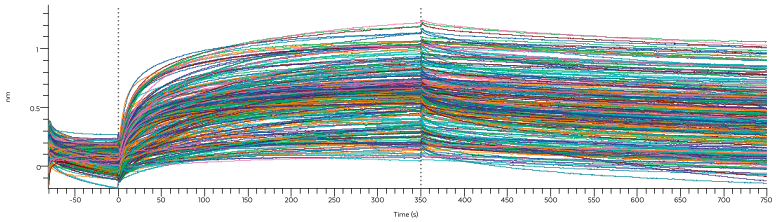
Off-rate ranking by BLI enables rapid comparison of the relative binding behavior of antibody candidates against a common antigen. Because the koff is independent of analyte concentration during the dissociation phase, reliable relative ranking can be achieved without precise antibody quantitation.
Importantly, off-rate measurements can be performed directly in crude hybridoma supernatants obtained from conditioned tissue culture media. This eliminates the need for purification or full kinetic characterization during early screening and allows large antibody cohorts (e.g., >100 clones) to be evaluated rapidly while minimizing sample consumption.
Sample Preparation Time
Eliminates purification requirements during early screening

Reagent Consumption
Minimal sample volume required for large-scale evaluation

Overall Screening Effort
Rapid triage of large antibody cohorts
Epitope Binning: Identifying Compatible Antibody Pairs
While off-rate ranking identifies strong binders, it does not determine whether antibodies recognize the same or different regions of an antigen. For many downstream applications—particularly sandwich ELISA, lateral flow assays, and other dual-antibody formats—epitope diversity is essential.
Rockland’s in-tandem epitope binning workflow uses sequential binding assays to evaluate competitive and non-competitive interactions between antibodies. This enables classification of antibodies into distinct epitope bins based on shared binding behavior, supporting identification of compatible antibody pairs and mapping of binding diversity across large panels.
Case Study: H5N1 Antibody Discovery Results
This integrated workflow was applied to characterize monoclonal antibodies targeting Highly Pathogenic Avian Influenza (HPAI) H5N1 clade 2.3.4.4b hemagglutinin, demonstrating the power of combined off-rate ranking and epitope binning for rapid antibody discovery.
100+
Hybridoma clones screened
4
Unique epitope bins identified
9
Final antibodies selected for commercialization
The complete characterization was accomplished within days rather than weeks, providing both relative affinity rankings and epitope diversity data essential for downstream assay development. This efficient screening identified optimal candidates from a large cohort while minimizing time and resource investment.
Apply These Workflows to Your Antibody Programs
Rockland’s integrated antibody discovery and characterization capabilities extend beyond this study, enabling rapid, high-confidence evaluation of antibodies against a wide range of targets. These workflows can be applied at any stage of development to support screening, selection, and assay design.
Bio-Layer Interferometry (BLI) Services
High-throughput kinetic analysis, off-rate ranking, and epitope binning using Octet® platforms to rapidly characterize antibody binding behavior and interaction profiles.
Custom Antibody Production
Development of monoclonal, polyclonal, and recombinant antibodies tailored to your target and application, with integrated screening strategies to identify high-value candidates early.
Protein & Antibody Characterization
Comprehensive analytical services including assay development, binding analysis, and functional characterization to support downstream research and diagnostic workflows.