ADA Assay Strategy Across the Drug Development Lifecycle
Successful immunogenicity testing depends on more than assay design alone. The quality and suitability of the reagents used throughout development, from early feasibility studies to clinical testing, can have a significant impact on assay performance, reproducibility, and long-term program success.
Because reagent requirements vary across therapeutic modalities and assay applications, developing the right strategy early helps reduce downstream risk and supports more efficient assay development. This guide outlines how custom anti-drug assay (ADA) reagents are developed across the drug development lifecycle, when different reagent types are appropriate, and how thoughtful planning can support both ADA and pharmacokinetic (PK) assay development.
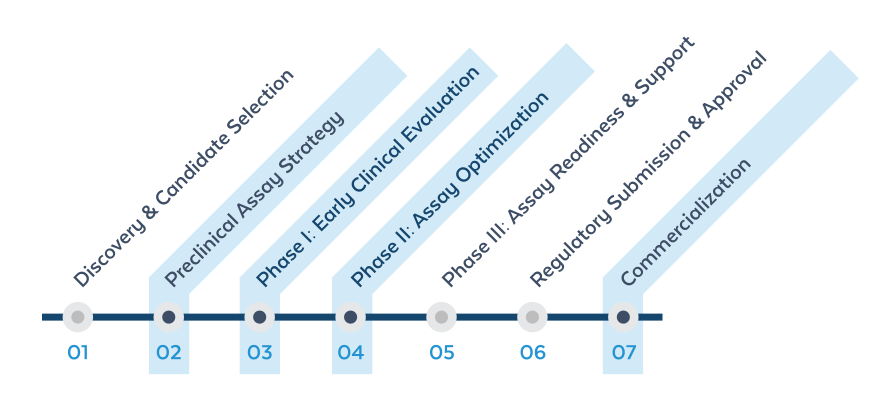
Preclinical Assay Strategy
Building the Right ADA Reagent Strategy Starts with your Therapeutic
The therapeutic format, whether an antibody, bi-specific, VHH, ADC, recombinant protein, peptide, or oligonucleotide, determines which reagent generation strategies are appropriate and which assay architectures are available downstream.
For antibody therapeutics, anti-idiotype (anti-ID) antibodies often play an important role in PK assays and can support aspects of immunogenicity assay development. For non-antibody therapeutics, reagent development typically focuses on generating anti-drug antibodies that recognize the therapeutic itself. Selecting the appropriate reagent strategy early helps ensure the resulting reagents are suitable for the intended ADA and PK assays, while minimizing redevelopment later in the program.
Immunogen strategy at this stage involves determining the target assay format, evaluating drug tolerance requirements, assessing whether surrogate antibodies are needed to support early feasibility, and selecting the appropriate immunogen preparation approach, including fragmentation, conjugation, Fc removal, or custom construct design based on the therapeutic format.
Rockland supports this phase through scientific consultation on assay structure, immunogen preparation, and custom reagent generation across protein, antibody, peptide, and nucleic acid therapeutic modalities.
Key Decisions that Shape ADA Assay Development
| Early Development Question | Why it Matters |
| What type of therapeutic is being developed? | Determines whether anti-ID antibodies, anti-drug antibodies, or both may be required |
| What is the intended assay application? | Influences reagent selection for ADA, PK, or other bioanalytical assays |
| What assay format is planned? | Affects reagent design, labeling strategy, and characterization requirements |
| Is therapeutic material available? | May influence immunogen preparation or the use of surrogate reagents during early development |
| Will long-term supply continuity be needed? | Helps determine whether recombinant conversion or production scale-up should be considered |
Preclinical Assay Strategy
Developing Anti-Idiotype Reagents for Antibody Therapeutics
Anti-ID antibodies are valuable reagents for antibody-based therapeutic development, particularly for PK assays and other applications requiring specific recognition of the therapeutic variable region. Because different assay formats place different demands on reagent performance, multiple anti-ID antibodies are often generated early in development to provide flexibility during assay optimization.
A panel of well-characterized anti-ID antibodies allows assay development teams to evaluate blocking and non-blocking clones, identify candidates for PK assay development, establish backup reagents in case the lead candidates underperform, and generate surrogate reagents when appropriate for early feasibility studies.
- Polyclonal anti-ID generation
- Polyclonal/monoclonal clone screening for idiotype specificity
- Hybridoma-based monoclonal antibody production
- Negative screening against human IgG and isotype controls
- B-cell cloning for rabbit monoclonal antibodies
- Purification via Protein A, Protein G, Protein A/G, or affinity purification
- Conventional and accelerated immunization strategies
- Binding characterization and stability assessment
Preclinical Assay Strategy
Developing ADA Reagents for Non-Antibody Therapeutics
For recombinant proteins, peptides, oligonucleotides, and other non-antibody therapeutic modalities, reagent development focuses on generating anti-drug antibodies that recognize the therapeutic molecule. The analytical reagents developed for these modalities require careful planning around how each reagent will be deployed and which types of assays it will support.
Polyclonal anti-drug antibodies are frequently used as positive control reagents in ADA assays because they recognize multiple epitopes across the therapeutic, producing a response that more closely reflects the heterogeneous immune response seen in patients. This multi-epitope recognition also makes polyclonal reagents valuable in absorption, distribution, metabolism, and excretion (ADME) studies, where they can detect both the intact therapeutic and its metabolites.
Depending on assay requirements, monoclonal antibodies may also be developed to support specific assay applications requiring well-defined binding characteristics. Examples of this would be a pharmacokinetic (PK) assay to quantify the drug concentration change over time in the matrix of interest.
It is often advantageous to have both a polyclonal and a monoclonal antibody against your therapeutic, allowing you to select the best reagent for each assay.
- Polyclonal ADA generation
- Hybridoma-based monoclonal ADA generation
- B-cell cloning for rabbit monoclonal antibodies
- Purification via Protein A, Protein G, Protein A/G, or affinity purification
- Conventional and accelerated immunization strategies
- Binding characterization and stability assessment
Where ADA Reagents Fit Across the Development Timelines
| Development Stage | Primary Reagent Focus |
| Preclinical | Immunogen design and custom reagent generation |
| Phase 1 | Initial ADA and PK reagent evaluation |
| Phase 2 | Reagent optimization and assay refinement |
| Phase 3 | Manufacturing scale-up and reagent characterization |
| Commercialization | Long-term reagent supply and lot continuity |
Early Clinical Evaluation
Pairing Reagents with Assay Architecture
Once candidate reagents have been generated, the next step is determining which are best suited for the intended assay format. For antibody therapeutics, anti-idiotype antibodies may be evaluated for applications such as PK assay development using techniques including biolayer interferometry (BLI) to identify compatible antibody pairs for sandwich assay formats.
For ADA assays, positive control reagents must demonstrate performance appropriate for the intended assay architecture. Depending on the therapeutic modality and assay design, this may involve polyclonal anti-drug antibodies, monoclonal antibodies, or other custom-generated reagents selected to support assay performance.
Rockland supports reagent characterization through binding analysis, affinity assessment, pairing studies, and assay format evaluation.
- BLI-based sandwich pairing studies
- High-affinity clone selection for confirmatory assays
- Format screening across bridging, sandwich, and competitive ELISA
- Positive control ADA reagent generation
- Binding characterization and affinity assessment
- ADA and PK assay format evaluation
Assay Optimization & Validation
Preparing Reagents for Assay Development
Once the appropriate reagent candidates have been identified, the focus shifts toward preparing those reagents for use within the intended assay platform.
Labeling and conjugation choices at this stage have a direct impact on assay sensitivity and platform compatibility. Biotin, HRP, alkaline phosphatase, and fluorochrome conjugates each serve different detection needs, and the right choice depends on the assay platform and the signal requirements of the method.
Fragment engineering is occasionally required when the intact antibody format introduces interference or steric issues in the assay. Recombinant conversion is worth considering at this stage for programs with longer development timelines or supply security requirements. Converting a hybridoma or B-cell derived clone to a recombinant format provides consistent long-term production independent of the original cell line.
- Custom labeling and conjugation, including biotin, HRP, alkaline phosphatase, and fluorochromes
- Compatible anti-ID clone production at development scale
- Fragment engineering for format-specific requirements
- Reagent characterization for assay suitability
- Recombinant conversion from hybridoma and B-cell derived clones
- Support for ELISA, bridging, and competitive assay formats
Clinical Supply & Lifecycle Management
Clinical-Scale Supply and Lot Continuity
As a program advances into later clinical phases, reagent supply becomes a different kind of problem. The assay is validated, the clones are selected, and the documentation is in place. What matters now is that the reagents performing in the clinic today are the same ones performing six months from now. Lot-to-lot variability in critical reagents is a regulatory problem as much as a scientific one, and planning for supply continuity needs to start earlier than most programs anticipate.
Formal GLP validation studies are conducted by sponsors or CRO partners. Rockland provides the reagents those studies require, along with the documentation to support their use in regulated environments.
- Production-scale custom reagent manufacturing
- Lot reservation programs
- Bulk reagent supply for clinical studies
- QC characterization and documentation
- Lot-to-lot consistency verificationt
- Long-term supply continuity planning
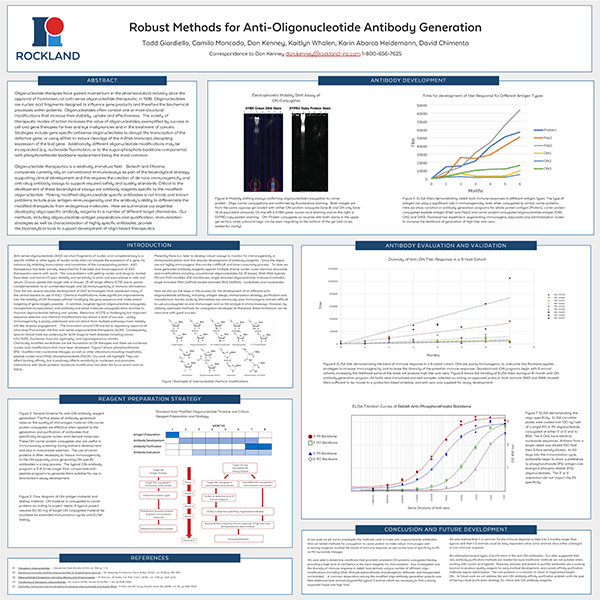
Case Study: Anti-Oligonucleotide Antibody Development
Oligonucleotide therapeutics present distinct challenges at the immunogen strategy stage. Nucleic acids are inherently poor immunogens, and programs typically run longer than comparable anti-peptide antibody generation campaigns.
Rockland has developed optimized conjugation and immunization methods for a range of oligonucleotide chemistries including:
- Phosphorothioate backbones
- DNA-RNA hybrids
- Single-stranded RNA
- Double-stranded RNA
These approaches help support anti-oligonucleotide antibody generation for ADA assay development programs.
Download Poster