Species-Specific Red Blood Cells for Immunology, Virology, and Hematology Research
Why Erythrocyte Model Selection Affects Assay Outcome
Red blood cells are more than oxygen carriers. As intact cells with preserved membrane architecture and native surface antigens, they serve as precise biological inputs across a range of immunological and virological assays.
The species you select directly affects assay sensitivity, receptor specificity, and complement response. Sheep RBCs are highly sensitive to lytic agents, making them the preferred model for hemolytic screening. Avian RBCs display receptors that preferentially bind influenza hemagglutinin, making turkey and chicken cells the standard for HAI and HA titration assays. Human and rabbit RBCs are established models for antibody adsorption and complement work.
Getting that selection right is the difference between a reliable assay and one that introduces variability at the source.
Key Distinction: Nucleated vs. Enucleated RBCs
Most mammalian RBCs are enucleated, providing a clean membrane model for lysis and complement assays. Avian RBCs (chicken, turkey) are nucleated and carry species-specific surface receptors critical for influenza hemagglutination work. Species choice is a methodological decision, not a sourcing convenience.
Applications by Research Area
Influenza and Viral Infection Research
Turkey and chicken RBCs are the standard erythrocyte models for hemagglutination-based virology. Turkey RBCs carry avian-type sialic acid receptors that bind influenza hemagglutinin with high affinity, making them well-suited for HAI assays measuring antibody-mediated inhibition of viral binding. Chicken RBCs, which are nucleated, are frequently used in HA assays to quantify viral particles and assess infectivity.
Hemolytic Safety Screening in Therapeutic Development
Before a compound advances toward clinical consideration, its hemolytic potential must be characterized. Human and sheep RBCs serve as the primary models for this gatekeeping step. Sheep RBCs are particularly sensitive to membrane disruption, providing a stringent in vitro screen. Human RBCs ground the data in the target biology.
Hematology and Diagnostic Development
Human RBCs serve as the primary erythrocyte model for hematological disorder research and diagnostic assay development, including antibody adsorption from human serum. Bovine and calf RBCs function as non-target controls in imaging and cell-based assays.
Antibody Research and Serum Processing
Human, sheep, and rabbit RBCs are used in antibody adsorption workflows to remove cross-reactive or non-specific antibodies from serum. Species selection depends on the antibody source and adsorption target.
Complement Studies and Adsorption Procedures
Guinea pig and rabbit RBCs are well-established in complement titration and adsorption workflows. Guinea pig RBCs are also used for the preparation of stroma as particulate reagents. Rabbit RBCs are commonly selected for adsorption procedures and HA assays requiring a highly reactive erythrocyte source.
Published Research: Peer-Reviewed Applications
The following represent recent, peer-reviewed studies in which Rockland's RBCs were the selected model.
Human Red Blood Cells
Rockland's human RBCs were used to measure hemolytic concentration as a critical safety evaluation step prior to compound advancement toward clinical consideration.
Application: Therapeutic Development | Hemolytic Safety Screening
Sheep Red Blood Cells
Rockland's sheep RBCs were selected to assess the hemolytic potential of a candidate peptide, serving as a required checkpoint before therapeutic development could proceed.
Application: Antimicrobial Research | Hemolytic Potential Assessment
Turkey Red Blood Cells
Turkey RBCs were used in HAI assays to evaluate the capacity of human monoclonal antibodies to block H7N9 influenza virus binding.
Application: Virology | Hemagglutination Inhibition
Chicken Red Blood Cells
Rockland's chicken RBCs were used in HA assays to titer influenza virus stocks, an essential step in quantifying viral load prior to downstream infection experiments.
Application: Virology | Hemagglutination Assay, Viral Titration
Selecting the Right RBC Model for Your Assay
Choosing an erythrocyte model is not interchangeable across workflows. The species origin directly determines receptor availability, membrane fragility, and complement responsiveness—each of which can materially affect assay sensitivity and interpretability. The matrix below provides a practical starting point for assay design.
| Assay Application | Recommended Species | Biological Rationale | Risk if Incorrect Model is Used |
| Hemagglutination Inhibition (HAI) | Turkey | α2,3-linked sialic acid receptors bind influenza hemagglutinin with high affinity | Reduced sensitivity to viral binding; underestimation of neutralizing antibody activity |
| Hemagglutination (HA) / Viral titration | Chicken | Nucleated erythrocytes support clear lattice formation for viral particle quantification | Poor lattice formation or inconsistent titration curves |
| Hemolytic safety screening | Sheep (primary), Human (secondary) | Sheep RBCs exhibit high membrane fragility; human RBCs provide translational relevance | False negatives in early screening or poor clinical correlation |
| Complement-mediated hemolysis | Guinea Pig | Robust complement activity and well-characterized lytic response | Weak or inconsistent complement activation signals |
| Complement fixation / titration | Sheep, Guinea Pig, Horse | Established pairing with complement pathways and hemolytic readouts; horse RBCs widely used in equine and veterinary complement protocols | Reduced assay sensitivity and poor reproducibility |
| Antibody adsorption (serum processing) | Human, Rabbit | Surface antigens enable selective removal of cross-reactive antibodies | Incomplete adsorption or unintended depletion of target antibodies |
| Hematology / diagnostic development | Human | Direct physiological relevance to target system | Limited translational value of findings |
| Imaging / non-target controls | Bovine/Calf | Minimal cross-reactivity in human-targeted systems | Background signal or assay interference |
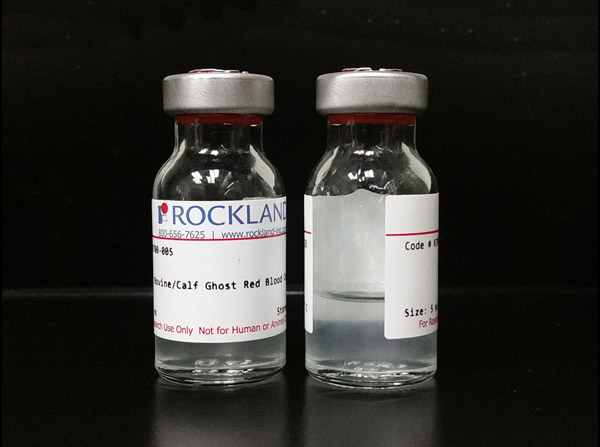
Ghost Red Blood Cells for Membrane and Drug Delivery Research
Processed under sterile conditions, ghost RBCs are derived from normal erythrocytes through controlled hypotonic lysis, producing membrane-sealed vesicles depleted of hemoglobin. They retain the native lipid bilayer and membrane protein composition of the parent erythrocyte, making them useful models for the study of biological membranes, phospholipid metabolism, and drug delivery systems.
Available from multiple host species including sheep, bovine, rabbit, and goat.
Explore Ghost RBCsProduct Quality and Lot Consistency
Rockland's RBCs are produced under controlled conditions to ensure consistent quality and minimal lot-to-lot variability. Each preparation is provided as a washed, stabilized, ready-to-use suspension, reducing preparation time and standardizing the biological input across experiments.
- Provided as a ready-to-use suspension at defined concentration
- Handled with a clean technique
- Minimal lot-to-lot variability to support reproducible assay performance
For projects requiring higher volume, custom species, or specific formulations, contact our technical team to discuss supply options.