Off-Rate Ranking & Epitope Binning for Monoclonal Antibody Characterization
Advanced Bio-Layer Interferometry (BLI) workflows for rapid antibody discovery and development
Successful monoclonal antibody (mAb) development requires more than identifying binders. For diagnostic and advanced research applications, antibody candidates must demonstrate appropriate affinity, dissociation kinetics, and epitope diversity to ensure downstream assay compatibility, stability, and reproducibility.
Traditional monoclonal antibody development programs often screen a limited number of clones and rarely differentiate relative affinity or epitope coverage across large cohorts. When relative affinity and binding relationships are critical, restricted screening increases development risk and may delay identification of fit-for-purpose reagents.
Rockland has integrated high-throughput off-rate ranking and in-tandem epitope binning into its standardized antibody discovery workflow using the Sartorius Octet® Bio-Layer Interferometry (BLI) platform. This approach enables screening of dozens to hundreds of hybridoma clones within days, providing decision-ready kinetic and epitope characterization early in the development process.
Epitope Binning: Identifying Compatible Antibody Pairs
While off-rate ranking identifies strong binders, it doesn't reveal whether antibodies recognize the same or different regions of the target antigen. For many applications—particularly sandwich ELISA, lateral flow assays, and other dual-antibody formats—epitope diversity is essential to enable compatible antibody pairing.
Rockland's in-tandem epitope binning workflow uses sequential binding assays to rapidly determine which antibodies compete for the same binding sites versus those that recognize distinct epitopes. This high-throughput approach can characterize binding relationships across hundreds of antibodies within days, providing the epitope diversity data needed for successful assay development.
Off-Rate Ranking: Rapid Antibody Triage
Methodology Overview
Off-rate ranking by BLI enables rapid comparison of the relative binding behavior of antibody candidates against a common antigen. Because the koff is independent of analyte concentration during the dissociation phase, reliable relative ranking can be achieved without precise antibody quantitation.
Importantly, off-rate measurements can be performed directly in crude hybridoma supernatants obtained from conditioned tissue culture media. This eliminates the need for purification or full kinetic characterization during early screening and allows large antibody cohorts (e.g., >100 clones) to be evaluated rapidly while minimizing sample consumption.
Standard Protocol
- Antigen Immobilization: His-tagged target protein immobilized onto HIS1K biosensors
- Baseline Establishment: Biosensors dipped into antigen-free media buffer
- Association Phase: Sensors introduced into neat hybridoma supernatants containing candidate antibodies
- Dissociation Monitoring: Biosensors transferred back into antigen-free buffer to monitor complex dissociation
Using Octet® Analysis Studio software, BLI sensorgrams are generated for each antibody candidate. The dissociation phase of each curve is analyzed to calculate experimental koff values. Antibodies are then ranked from slowest to fastest dissociation, with slower koff values interpreted as stronger relative binding.
Workflow Advantages
Unlike traditional workflows that require purification and full 1:1 kinetic analysis of each clone, off-rate ranking significantly reduces:

Sample Preparation Time
Eliminates purification requirements

Reagent Consumption
Minimal sample volume required

Overall Screening Effort
Rapid evaluation of large cohorts
As a result, large antibody discovery campaigns can be triaged efficiently prior to deeper biophysical characterization.
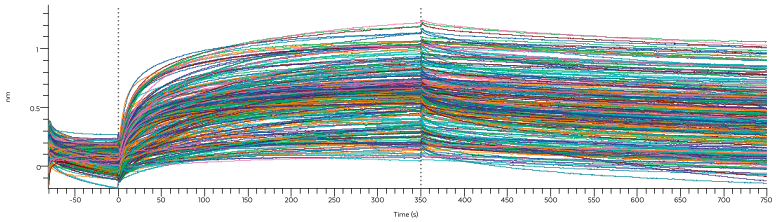
Figure 1. Sensorgram overlay of Off-Rate ranking data. An 80s baseline in buffer is followed by a 350s association step in antibody SUP before a 400s dissociation in the same buffer. Software-assisted curve fitting was performed on the dissociation step to calculate off-rate of each antibody against the common antigen HA protein.
Case Study: H5N1 Antibody Discovery Results
This integrated workflow was applied to characterize monoclonal antibodies targeting Highly Pathogenic Avian Influenza (HPAI) H5N1 clade 2.3.4.4b hemagglutinin, demonstrating the power of combined off-rate ranking and epitope binning for rapid antibody discovery.
100+
Hybridoma clones screened
4
Unique epitope bins identified
9
Final antibodies selected for commercialization
The complete characterization was accomplished within days rather than weeks, providing both relative affinity rankings and epitope diversity data essential for downstream assay development. This efficient screening identified optimal candidates from a large cohort while minimizing time and resource investment.
Available Services & Applications
Custom Antibody Characterization
Rockland's BLI-based screening services can be applied to antibodies targeting any protein of interest. Our integrated workflow provides rapid, comprehensive characterization to accelerate your antibody discovery and development programs.
Off-Rate Ranking
Relative affinity screening for large clone cohorts using crude supernatants
Epitope Binning
Competition analysis for antibody pairing compatibility and assay development
Integrated Antibody Development
Combine characterization services with Rockland's comprehensive antibody development capabilities:
- Custom Antibody Production - Including monoclonal, polyclonal, anti-oligo, anti-ID, and recombinant antibodies
- Bio-Layer Interferometry Services - Comprehensive BLI characterization and kinetic analysis
- Recombinant Antibody Services - Including conversion, affinity maturation, library screening, and VHH development
- Protein & Antibody Characterization - Including assay development and additional analytical services
Ready to Accelerate Your Antibody Discovery?