ADA Assay Strategy Across the Drug Development Lifecycle
Starting with strategy: how your therapeutic format shapes everything downstream
Most ADA assay problems that surface during validation trace back to decisions made long before the first antibody was generated. The format of your therapeutic, whether a monoclonal antibody, bispecific, VHH, ADC, fusion protein, or oligonucleotide, directly determines which immunogen approaches are viable, which anti-ID formats can be generated from those immunogens, and ultimately which ADA and PK assay architectures are available to the program. A mismatch at any point in that chain is difficult and expensive to correct later.
Immunogen strategy at this stage involves determining the target assay format, evaluating drug tolerance requirements, assessing whether surrogate antibodies are needed to support early feasibility, and selecting the appropriate immunogen preparation approach, including fragmentation, conjugation, Fc removal, or custom construct design based on the therapeutic format.
Rockland supports this phase through scientific consultation on assay architecture and immunogen preparation across protein, antibody, peptide, and nucleic acid therapeutic formats.
Generating the anti-ID panel: why one antibody is rarely enough
Anti-idiotype antibodies are the reagent backbone of both ADA and PK assays. An anti-ID that works well in a bridging ADA assay requires different binding characteristics than one designed for a PK sandwich assay, and a single clone rarely satisfies both. Regulatory expectations compound this further. FDA guidance on immunogenicity testing acknowledges that ADAs can bind multiple targets, present across multiple domains, and require more than one assay to fully characterize. Programs that enter validation with a single anti-ID clone carry real risk if that clone underperforms.
Developing a panel of anti-ID antibodies early in the program addresses this directly. A well-designed panel gives the assay development team options: blocking and non-blocking clones for different assay formats, backup reagents if a lead clone fails during validation, and surrogate antibodies to support feasibility work when therapeutic material is limited or timelines are compressed. Surrogate antibodies are particularly valuable in early development, where the priority is establishing assay architecture before the therapeutic itself is fully available.
- Polyclonal anti-ID generation
- Hybridoma-based monoclonal antibody production
- B-cell cloning for rabbit monoclonal antibodies
- Conventional and accelerated immunization strategies
- Clone screening for idiotype specificity
- Negative screening against human IgG and isotype controls
- Purification via Protein A, Protein G, Protein A/G, or affinity purification
- Binding characterization and stability assessment
Where anti-ID and ADA reagents fit across the development timeline
ADA relevance
Immunogen prep, early ADA inclusion in tox studies
Rockland role
Immunogen design and anti-ID generation
ADA relevance
Initial PK and ADA screening
Rockland role
Clone generation and pairing
ADA relevance
Dose finding and optimization
Rockland role
Assay refinement and engineered formats
ADA relevance
Large efficacy trials with ADA/PK screen
Rockland role
Scaled manufacturing and lot control
ADA relevance
Ongoing monitoring
Rockland role
Long-term supply continuity
Preclinical
ADA relevance
Immunogen prep, early ADA inclusion in tox studies
Rockland role
Immunogen design and anti-ID generation
Phase I
ADA relevance
Initial PK and ADA screening
Rockland role
Clone generation and pairing
Phase II
ADA relevance
Dose finding and optimization
Rockland role
Assay refinement and engineered formats
Phase III
ADA relevance
Large efficacy trials with ADA/PK screen
Rockland role
Scaled manufacturing and lot control
NDA / Market
ADA relevance
Ongoing monitoring
Rockland role
Long-term supply continuity
Pairing and format selection: connecting reagents to assay architecture
Clone pairing is where an anti-ID panel becomes a functional assay. Before pairing studies are useful, the assay format question has to be resolved: bridging or indirect for ADA, sandwich or competitive for PK. Those choices determine what binding characteristics matter in a clone and which pairs are worth evaluating. Running pairing studies before that decision is made produces data that may not be actionable.
Biolayer interferometry (BLI) is the standard approach for sandwich pairing characterization, allowing rapid evaluation of clone combinations for simultaneous binding. At this stage the program also needs to confirm that the selected anti-ID clones perform as positive controls in the intended assay format, which is a separate question from whether they pair well structurally.
- BLI-based sandwich pairing studies
- Format screening across bridging, sandwich, and competitive ELISA
- Binding characterization and affinity assessment
- High-affinity clone selection for confirmatory assays
- Positive control anti-ID generation
- ADA and PK assay format evaluation
Assay development and optimization: preparing reagents for the assay
Once the anti-ID panel is narrowed to the clones that perform in the intended format, the focus shifts to getting those reagents ready for assay use. Labeling and conjugation choices at this stage have a direct impact on assay sensitivity and platform compatibility. Biotin, HRP, alkaline phosphatase, and fluorochrome conjugates each serve different detection needs, and the right choice depends on the assay platform and the signal requirements of the method.
Fragment engineering is occasionally required when the intact antibody format introduces interference or steric issues in the assay. Recombinant conversion is worth considering at this stage for programs with longer development timelines or supply security requirements. Converting a hybridoma or B-cell derived clone to a recombinant format provides consistent long-term production independent of the original cell line.
- Custom labeling and conjugation including biotin, HRP, alkaline phosphatase, and fluorochromes
- Fragment engineering for format-specific requirements
- Recombinant conversion from hybridoma and B-cell derived clones
- Compatible anti-ID clone production at development scale
- Reagent characterization for assay suitability
- Support for ELISA, bridging, and competitive assay formats
Clinical-scale supply and lot continuity
As a program advances into later clinical phases, reagent supply becomes a different kind of problem. The assay is validated, the clones are selected, and the documentation is in place. What matters now is that the reagents performing in the clinic today are the same ones performing six months from now. Lot-to-lot variability in critical reagents is a regulatory problem as much as a scientific one, and planning for supply continuity needs to start earlier than most programs anticipate.
Formal GLP validation studies are conducted by sponsors or CRO partners. Rockland provides the reagents those studies require, along with the documentation to support their use in regulated environments.
- Production-scale anti-ID manufacturing
- Lot reservation programs
- Bulk reagent supply for clinical studies
- QC characterization and documentation
- Lot-to-lot consistency verification
- Long-term supply continuity planning
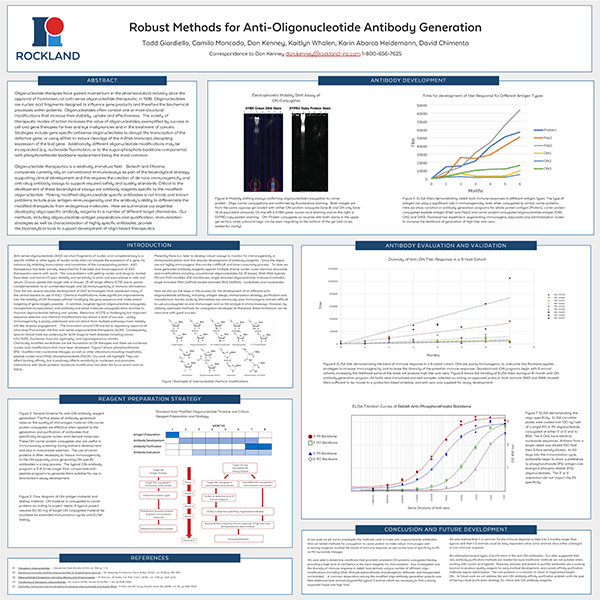
Robust Methods for Anti-Oligonucleotide Antibody Generation
Oligonucleotide therapeutics present distinct challenges at the immunogen strategy stage. Nucleic acids are inherently poor immunogens, and programs typically run three to four times longer than comparable anti-peptide programs. Rockland has developed optimized conjugation and immunization methods for a range of oligonucleotide chemistries including phosphorothioate and phosphorodithioate backbones, DNA-RNA hybrids, and single and double stranded RNA.
View poster
Ready to advance your biologic's immunogenicity program?
Ready to build your ADA testing strategy? Our scientists are here to help at every stage of development.